
Amid the uproar over the first India-South Africa Test which ended in three days, experts share their opinion on giving batters and bowlers an equal opportunity
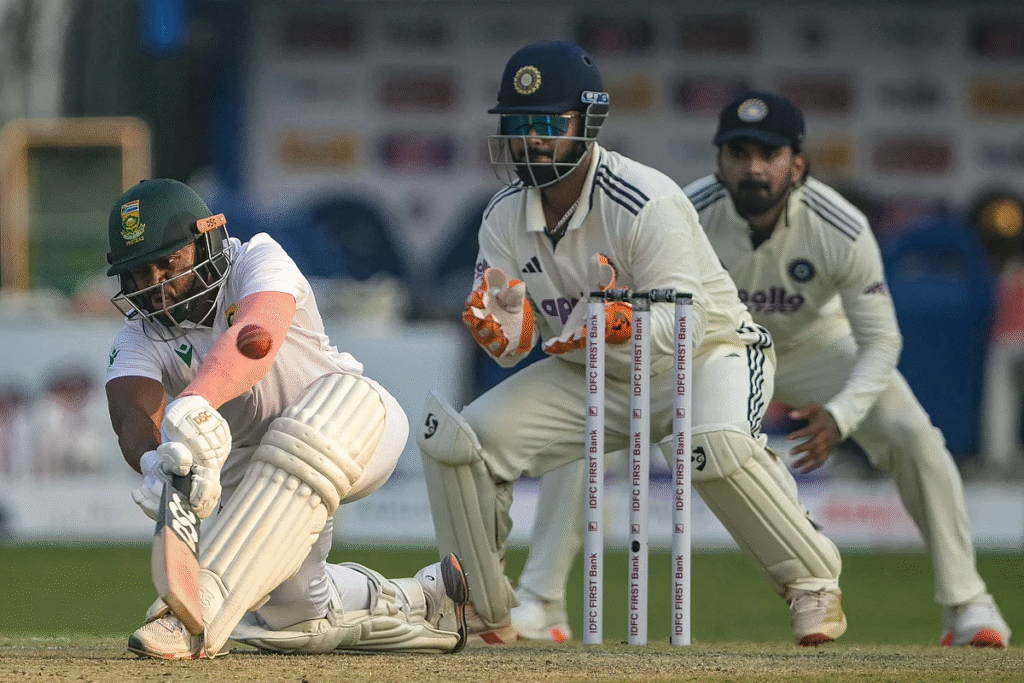
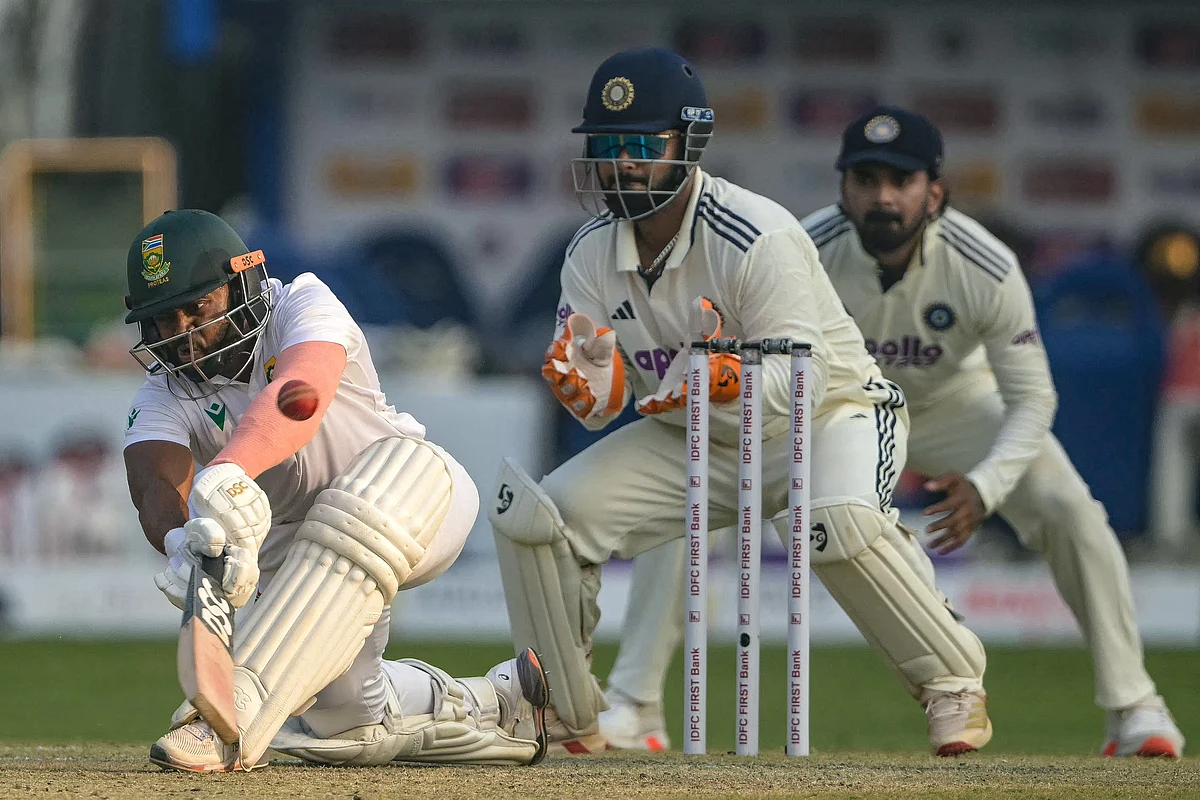
South Africa’s captain Temba Bavuma (left) plays a shot during the second day of the first Test at the Eden Gardens.. Photo: AFP
What makes cricket truly fascinating is that no other sport offers the home nation the luxury of preparing a surface to suit the strength of its team.
In India, Pakistan or Sri Lanka, for that matter, your team is expected to play on dust bowls where spinners weave magic with their turn and guile, bringing foreign batters to their knees.
But the surfaces in South Africa, Australia, England and New Zealand — countries with vastly different weather and soil conditions — support genuine pace and swing bowling that challenge the skills and temperament of Asian batters raised on slow pitches.
Stay up to date with the latest news. Follow KT on WhatsApp Channels.
In all other sports, including football, the playing surface has uniformity, and the only advantage the home team enjoys is the passionate support from its fans, who push travelling fans to small pockets in the stands.
It’s only cricket which offers teams the chance to embrace immortality by winning in alien conditions, especially in Test matches.
The traditional format of the game has seen some iconic teams, especially the West Indies of the 1970s and 1980s, that conquered almost every country they set foot in.
But teams have traditionally relied on the home advantage, preparing pitches to gain an upper hand.
This trend has become more pronounced in the past seven years after the launch of the World Test Championship. The two-year WTC cycle — based on a points system to determine the two finalists —has thrown Test cricket into strategic chaos.
Desperate to hold on to every point on offer to reach the final, teams are now adopting the ‘home pitch’ policy with unprecedented aggression.
The recent Test match between India and South Africa at Eden Gardens, one of the most iconic cricket stadiums, saw batters fall like ninepins on a turning track.
Ironically, it was India that bit the dust with South Africa pulling off a shock win on the back of their spinners, who outperformed the home spin-attack.
But what hurt the purists was not the manner of India’s defeat as the home team, chasing 124 on the third day, slumped to 93 all out.
It is rather the inability to prepare pitches that can produce enthralling five days of Test cricket, which has triggered a storm.
Has the home teams’ interference pushed curators to the brink, resulting in wickets where the balance is heavily tilted in bowlers’ favour?
Poor advertisement
Legendary Indian batsman Dilip Vengsarkar believes such wickets are a poor advertisement for a format struggling to survive in the T20 era.
“Spinners coming into play on the first day of a Test match is never a good sight,” Vengsarkar told the Khaleej Times.
Dilip Vengsarkar
Dilip Vengsarkar
“Who wants to see a spinner operating in the first hour of a Test with five close-in fielders crowding the bat? Yes, 40,000 people turned up each day (at Eden Gardens), but I doubt they got their money’s worth.”
Vengsarkar, the former chairman of India’s selection committee who famously fast-tracked an 18-year-old Virat Kohli to the Indian team in 2008, says the onus is now on the BCCI (Board of Control for Cricket in India), the world’s most powerful cricket board, to provide a level playing field.
“The Indian board should be leading the way in world cricket, ensuring that spectators watch Test matches on proper surfaces — ones that offer a fair contest and give batters and bowlers an equal opportunity to show their skills,” the former Indian captain said.
Two-day Test!
Since 2018, when the WTC was launched, there is a sharp rise in Test matches that finished in three days.
Several Test matches during this period even ended in two days, with the South Africa-India Test in Cape Town seeing the fall of 23 wickets on the opening day.
To avoid such embarrassing scorecards, Venkat Sundaram, former chairman of the BCCI pitch committee, had suggested an innovative plan during an ICC (International Cricket Council) meeting in 2011.
“In 2011, we had a curators’ meeting at the ICC headquarters in Dubai. During that meeting, I suggested that the idea of “home advantage” and “home disadvantage” should be reviewed, because pitches can always be tweaked to favour the home team,” Sundaram told the Khaleej Times.
Venkat Sundaram
Venkat Sundaram
“Take South Africa, for instance: with their fast-bowling attack, they often produce under-prepared wickets where matches finish in two or three days. In England, too, you sometimes see pitches with nearly 14 millimetres of grass left on them. Australia plays its first Test of the summer on the bouncy Perth wicket. Then, when these teams tour India, they receive the same kind of treatment in reverse.”
‘Neutral’ curators
So what Sundaram advised was to draw a plan to introduce ‘neutral’ curators for Test matches.
“I proposed at that ICC meeting that Test cricket should have neutral curators. Why not have an Indian curator working during an Ashes series, and Australian or English curators supervising India’s home Tests against other teams? This would help strike the right balance without losing the essence of Test cricket,” he said.
“The WTC is based on a point system; this often leads to doctored pitches as home teams put pressure on curators to prepare pitches that suit them.
“Which is precisely why a neutral curator, overseeing preparations alongside the local curator who understands the soil, conditions and weather, would lead to more balanced, competitive wickets.
“After all, we already have neutral umpires in Test cricket — so why not neutral curators?”
Sundaram, a former first-class cricketer, fears for the future of the game’s oldest format if teams continue to aggressively exploit the home advantage.
“If we want the format to survive, we need wickets that consistently produce five days of intense, dramatic Test cricket,” he said. “That is the lifeblood of this game.”